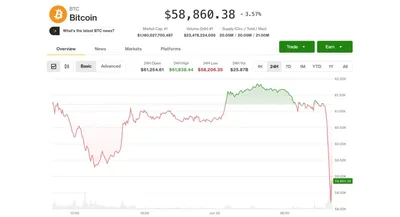
Bitcoin's Drop to $58K Looks Normal Under Power-Law Model
BTC's slide to $58,000 fits the power-law model's cycle low range, though futures data hints at more downside ahead.

If you've been watching Bitcoin bleed down toward $58,000 and wondering whether it's time to panic, one popular analytical framework is here to tell you to take a breath. The power-law model — a mathematical tool that maps Bitcoin's price trajectory on a logarithmic scale over time — actually frames a drop to that level as a completely normal cycle low, not some catastrophic breakdown.
So what's the power-law model, exactly? Think of it as a long-range GPS for Bitcoin's price. Instead of reacting to every weekly candle, it smooths out the chaos and draws a corridor where BTC prices have historically landed during bear phases. According to this model, $58,000 isn't a disaster — it's right in the ballpark of where cycle bottoms tend to show up.
Read more SBI to Buy Bitbank for $289M, Forming Japan's Top Crypto Exchange →
Here's the catch, though: futures market data isn't quite as chill about all this. Derivatives positioning suggests traders are bracing for prices to dip even lower than $58K before any meaningful recovery kicks in. Futures markets tend to reflect where institutional and professional traders are placing their bets, and right now those bets lean toward additional downside pressure on BTC.
The tension here is classic crypto: long-term structural models say everything is fine, while short-term market mechanics flash caution. Neither view is necessarily wrong — they're just operating on different time horizons. Long-term holders leaning on the power-law framework might see current prices as an opportunity, while active traders watching futures open interest and funding rates might want to stay nimble.
Bottom line: whether $58,000 marks the floor or just a pit stop on the way lower depends heavily on which lens you're using. The power-law model offers reassurance for the patient crowd, but derivatives traders are keeping the pressure alive. Continue reading at Cointelegraph.